
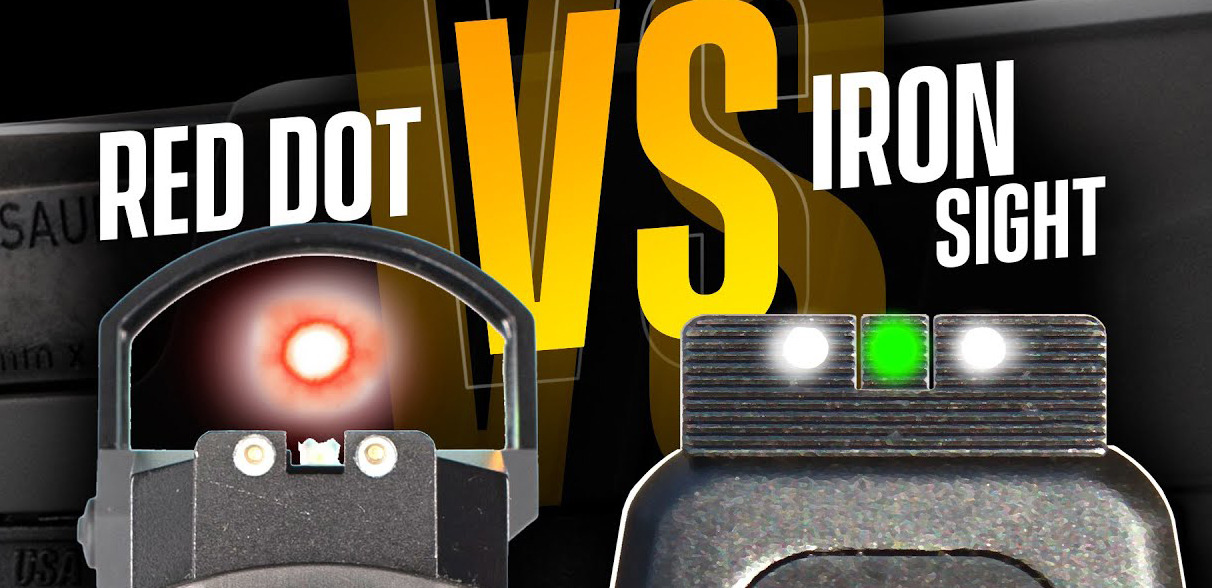
Red Dot or Iron Sights: Which is the best choice to put on my pistol? -by Adam Keith
"Should I choose a pistol with iron sights, or a red dot optic? Which is better? " The internet is ablaze with fervent discussions and even heated arguments, and acolytes of both camps are equally committed to the superiority of their preference. The surprising truth is, it may not make as much of a difference as you think. With that possible spoiler in front of us, let's explore the pros and cons of both systems, keeping an open mind. The fact of the matter is, as with many things, much depends on the quality of the gear chosen, the applications the gun and sight is intended for, and--most importantly--the training commitment of the end user to gain skill with whichever system they settle on.
Iron sights—which may in fact not be made of metal, as is the case with the rudimentary plastic sights Glock has always put on their products—refers to classic sights that offer a square or U-shaped notch in the rear, and a post in the front which snuggles down in the middle of the rear sight, when the user is aligning them correctly. If the front post is too high, too low, or too far off to the left or right within the notch, hits on target veer off course to some degree in according fashion. Some iron sights, such as those set up for bullseye shooting, are often adjusted or regulated for a "six o clock" hold, where the bullet impacts on target several inches over the top of the front post hold. Others, including most pistols intended for duty or carry use, have a "combat" regulation; here, what the front sight directly covers is where the bullet impact should occur. This is a subtle difference, and subject to shooter preference for those who choose basic iron sights, but it is important to understand where your sight system is designed to deliver rounds, so you know exactly where bullets will go in a crucial moment, be it range practice, a competition, or something far more grave—defending your life.
Miniature Red Dot sights (which may be in colors other than red), long in vogue on rifles like the popular AR-15, have swept the pistol scene in the last decade, with increasing numbers of shooters opting to mount one on their pistols. While top competitive pistol shooters in USPSA began the charge to iron sights in the 1990s with early (and very bulky) technology, current dot sights have become both small and extremely rugged in the best models, and well suited for the most demanding duty, competition and carry applications. Properly zeroed, the red dot optic can deliver superb accuracy for the practiced handgun user, while easily enabling them to consistently maintain target focus—-that is, the exact spot on the target they wish to stack bullets—rather than getting sucked into aligning sights and/or darting back and forth between the target area and the sight system. Due to their brilliant electronic illumination, they also show up extremely well in dim light, far better than even a set of iron sights with glowing tritium "night sight" inserts. Various options in dot size (expressed in "Minutes of Angle" or MOA) enable the shooter to choose optics ideal for longer range or more precise shots on target, or ones with a larger dot better suited to faster and looser applications, such as pistol action shooting within 30 yards; in scenarios like the latter, blazing speed with sufficient accuracy is the main priority and a bigger dot often appears more easily to the eye. While shooting, the up-and-down bounce of the electronic dot in the window during recoil gives the shooter copious feedback about their grip, trigger press quality, and other variables—-in a sense, "coaching" your brain and eyes as you run the pistol. You begin to instantly grasp when shots have been executed well, and on the flip side, irregular dot movements (the dot slashing leftward, or a shot breaking with dot very high in the window, etc.) abruptly scold that your fundamentals were less than ideal...and something your target will reveal when you go downrange. From here, its back to the drawing board to reassess technique and make the adjustments that will create improvement; beyond any "cool factor" that red dot sights have due to current market trends, the educational aspect of a dot to a studious shooter is extremely valuable and has been one of the biggest surprises for me in using them.
Now that basic discussion of irons versus an electronic dot sight has been laid out, let's explore some finer points and a personal perspective. I will state without any equivocation, that switching to red dot sight in the last half decade has improved my modest pistol shooting ability significantly, largely due to the visual cues they give as mentioned a moment ago. For the committed shooter who trains regularly, the red dot gives subtle but notable advantages over iron sights—it's not that irons don't communicate information to you while you shoot, but the dot is much more blatant about it. Use of a red dot also forced me to work on the quality of my presentation to the target; with iron sights, the rear window is sort of a "training wheel set", so a shooter can be a bit sloppy when bringing the gun up—-with a red dot, if the presentation isn't clean and exacting, the shooter may not even see the red dot in the window. This is something we frequently observe on the range with newbies, who desperately move the gun muzzle up and down, or dip their heads in various directions, baffled as to why they can't find a supposedly bright electronic dot. That said, once you are able to find the dot in an instant as you present the gun outward, your efficiency in delivering accurate, fast shots improves dramatically—and this also directly translates over to any pistol wearing iron sights. As a result of frequent practice with a red dot equipped pistol, I can now pick up most any handgun—red dot equipped or not-- and get fast, consistent results with little effort. And, while bullseye shooters have long held the mantra of "front sight focus for accuracy"—-fast vitals-focused hits with iron sights can be made at any reasonable combative distance, simply by being aware of the sights (present but blurry in the background) all while staying focused on the area of the target I wish to send rounds into. This is where the training continuum between iron sights and red dots begins to merge into a unified whole; once a competent instructor successfully imparts the concept of "Target Focused Shooting" to the student, it starts to matter less and less which system is employed. Red dot-mounted pistols do maintain speed and accuracy advantages after 20 yards for many, but within 15 yards and in—where the vast majority of pistol usage occurs-- I find little practical difference.
With all their technological and visual advantages, where do red dots become a liability? One example is the shooter who doesn't train, and has little interest in shooting beyond a novelty, occasional hobby activity, or intends to "throw the damn gun in a drawer and forget about it" after purchase. (This of course is a terrible attitude to have, regardless of gun or sights chosen) For all their pros, red dots add notable complexity and cost to the handgun purchase: you now have one system (the battery-powered electronic optic) joining to another system (the pistol) and these need to be secured correctly together via yet another system (mounting plates and/or screws). These add points of possible failure that, while not a problem for the trained and attentive, may pose significant issues down the road for the neophyte who has little interest in firearms and training beyond the absolute minimum. Has the optic shifted zero under use or hard knocks, or lost a screw? Is the battery dead, and in need of a replacement? The dedicated user will no doubt maintain awareness because they inspect and frequently shoot their gear, while a casual user may never see potential failure coming, or perform the simplest preventative maintenance (such as an annual battery swap) as needed. This is before considering the fact that a gun with a quality optic is notably more expensive, and sometimes more than doubles the financial commitment, compared to a pistol with simple iron sights. Pistols carried openly in harsh outdoor environments can create issues with some red dots, if an open emitter red dot optic like the popular Trijicon RMR Type 2 or Holosun 508T gets filled with snow, mud, or debris; now, this problem can be partly mitigated by training, or largely solved by the choice of a closed emitter dot like the Trijicon RCR or Aimpoint Acro (where glass covers both ends of the optics) or well-designed holster, but it is certainly something to consider. Guns carried in pocket holsters, such as a snub-nosed revolver, are often not the best host for optical sights either, due to their tactical niche and need for minimal bulk, although there are a new generation of micro red dot optics that can be excellent combos for handguns in deep concealment roles.
All of this is not to say that iron sights are infallible, as some traditionalists emphatically insist. Unless we're talking about something like old revolver sights where the front sight was literally integral with the steel barrel, most simple sights in contemporary pistols are removable, and hence, can slide out of dovetails, lose a set screw and detach, get knocked off by a hard blow, or lose high visibility night sight inserts. As with a red dot sight, it behooves the user to perform occasional inspections to make sure that all is well. That said, a quality, well-fitted set of basic sights certainly have fewer points of failure to consider, are simpler in their setup, lower in cost, and theoretically more "bomb proof". Again, as with choosing a red dot sight, irons should be of top quality, whether they are factory installed, or an aftermarket add-on correctly mounted by a knowledgeable smith. Glock is a good example of a company producing sheer mediocrity in standard sights; while the pistols have long set an enviable standard of reliability, the plastic stock sights are pretty dismal in both durability and sight picture on target. For those Glock users who aren't quite ready for a red dot but want to perform their best, upgrading these rudimentary plastic lumps to metal sights from the likes of Trijicon, Ameriglo, Wilson Combat, or Dawson Precision is advised, and can make a big difference in the speed, usability, and durability of their gun and sight system.
To conclude, a shooter with an attitude to train and grow their skills, can become remarkably proficient with either basic iron sights, or a red dot; the high-tech latter has not invalidated the proven track record of the low-tech former. That said, the red dot sight system definitely offers major advantages in training and on-target performance that are hard to ignore for the dedicated shooter. It is for these reasons the popularity of quality optics from brands like Holosun, Trijicon and Aimpoint will only continue to increase; no mere passing fad, they are where the market and dedicated training community will continue to gravitate to. Those choosing to embrace this technology from the outset must simply understand that the financial outlay for a quality red dot setup will be greater, they will need to train attentively to master it, and be more dialed in in terms of maintenance points. On the flip side, for those less sure of their commitment level to pistol training, the choice to get started with a reliable firearm wearing good quality basic sights, and developing solid target-focused shooting fundamentals may be a prudent one; later, as skill and dedication become more honed, such a person can always upgrade their pistol with a quality red dot that suits their visual preferences.
At the end of the day, the prospective student may— as I have—discover that both systems are valid, and good results achievable with either. I enjoy red dot equipped pistols such as my Walther PDP with Trijicon RCR, and my iron sighted choices like the HK USP Compact equally, and find no contradiction in that duality. In future articles we'll further explore popular makes and models of optics available, all of which you can purchase through our team of helpful professionals here at West Coast Armory.